
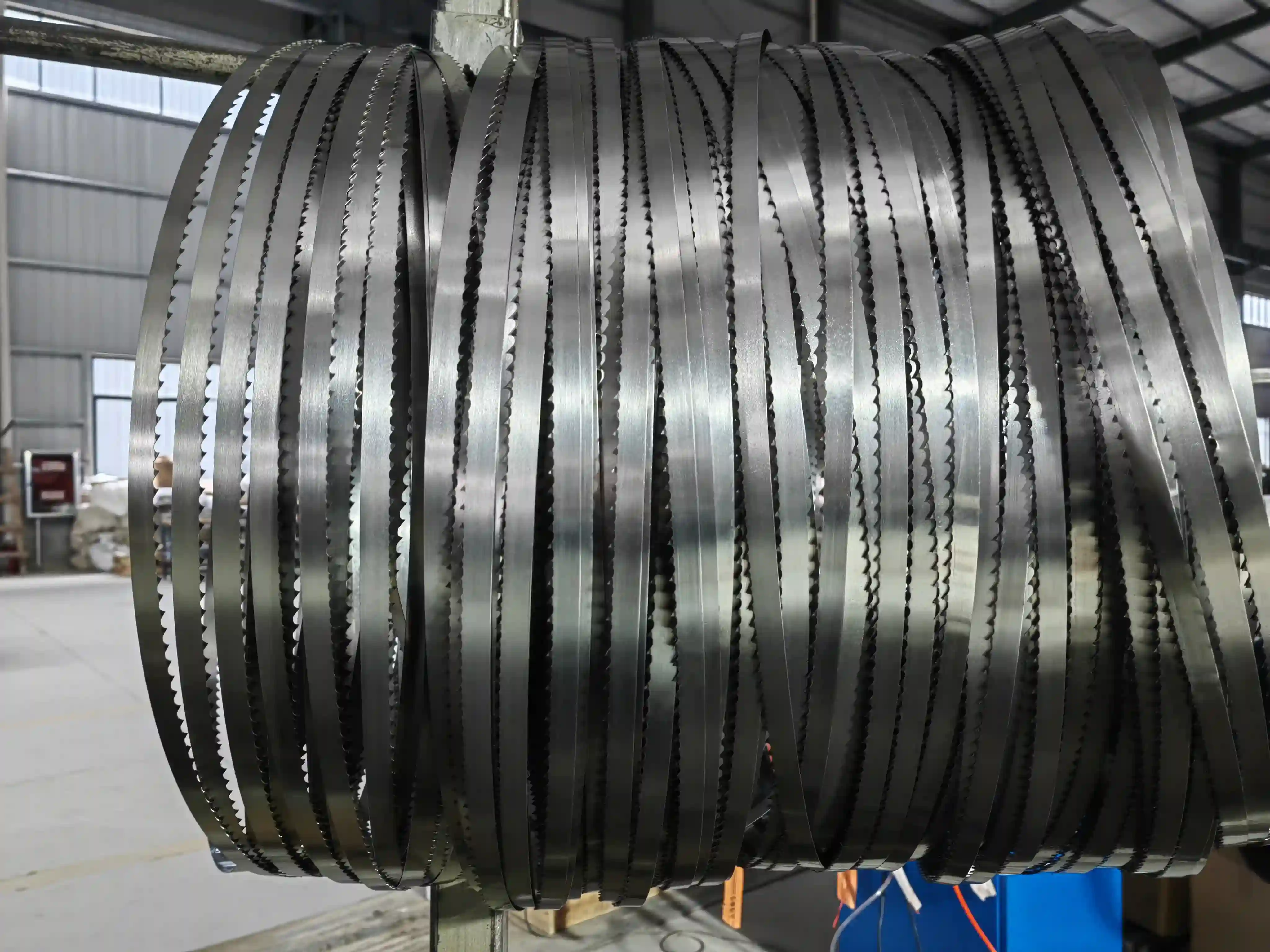
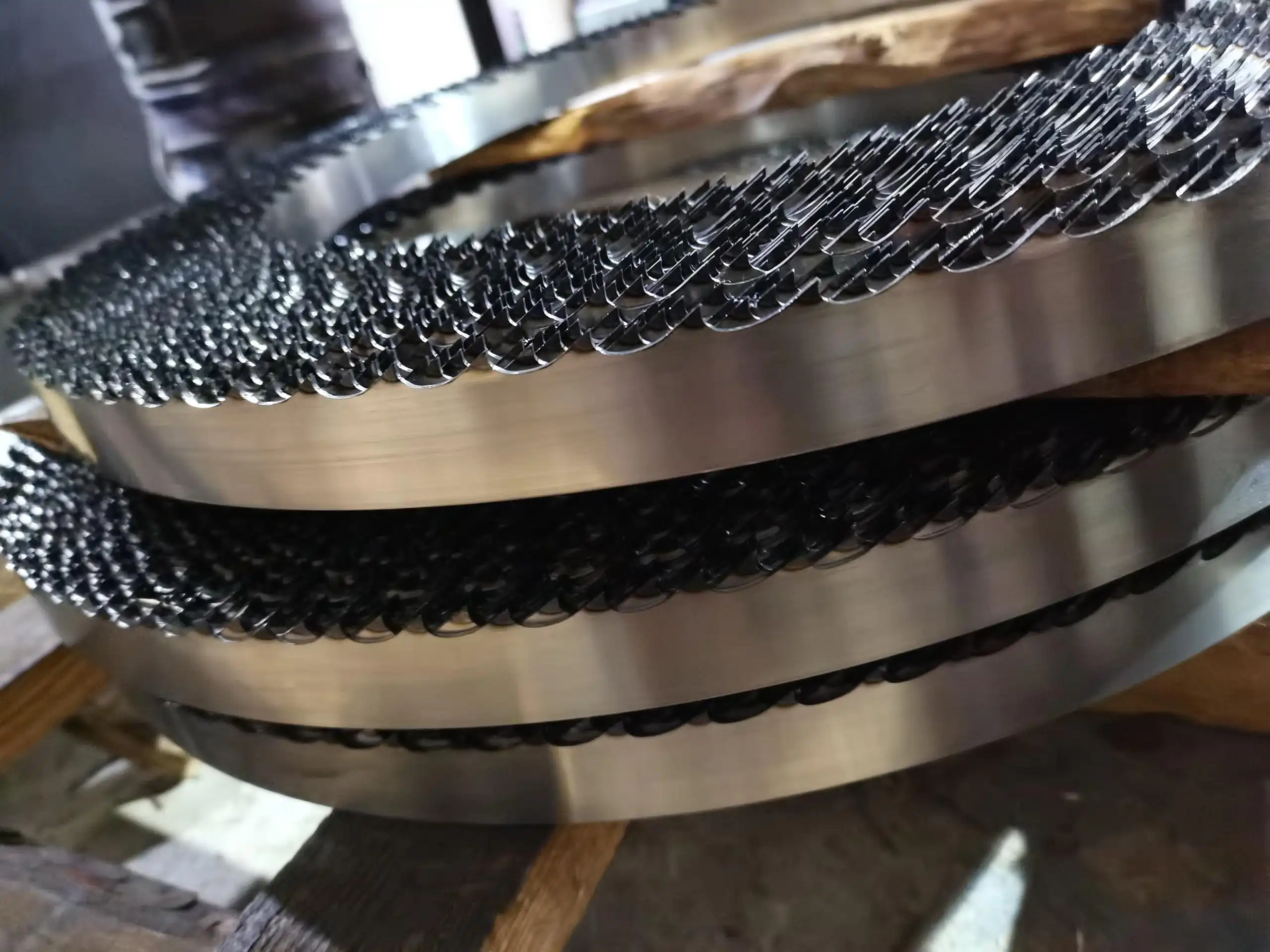
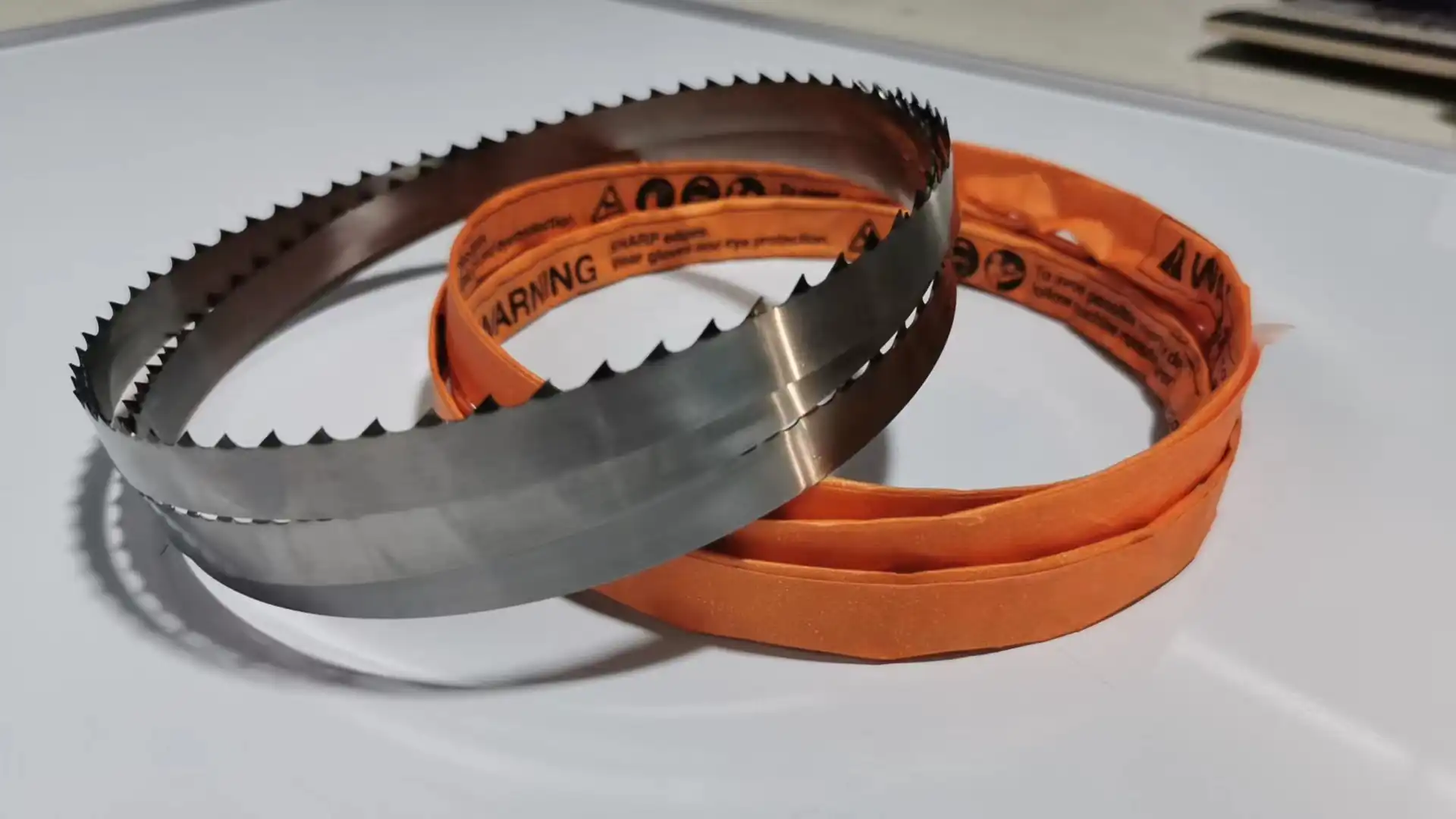
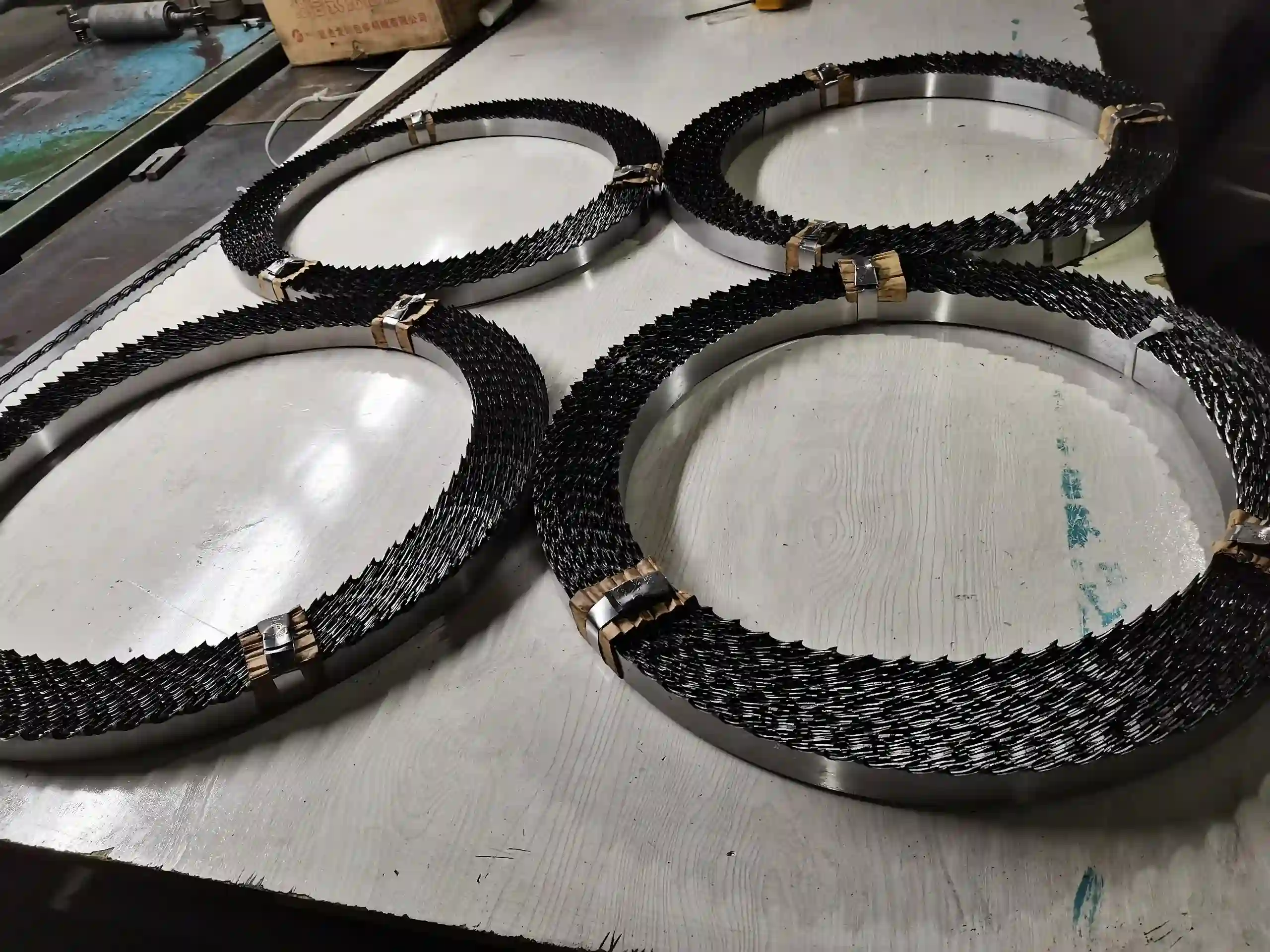
What Is This Product?
Mining Metal Cutting Band Saw Blades are bimetal band saw blades made with a high-speed steel (HSS) tooth edge and a spring-tempered alloy steel backing. The tooth tip and backing are joined by electron beam welding.
They are used to cut:
-
Carbon steel and low-alloy steel
-
Structural steel such as I-beams, H-beams, angle iron, and channel
-
Heavy steel plate
-
Transmission shafts, pins, and hydraulic rods
-
Pipe and thick-wall tubing
-
Wear-resistant plates and components
The key application is mining machinery fabrication and maintenance, not ore extraction. Band saw cutting provides a narrow kerf, high dimensional accuracy, and no significant heat-affected zone compared with flame cutting or abrasive cutting.
Target Applications
| Application | Typical Material | Recommended Tooth Material | Recommended TPI |
|---|---|---|---|
| Mining Equipment Fabrication | Carbon steel / low-alloy plate | M42 | 3/4–4/6 |
| Structural Steel Cutting | I-beam, H-beam, angle, channel | M42 | 3/4–5/8 |
| Heavy Plate Cutting | 20–200 mm carbon / wear plate | M42 / M51 | 1.4/2.0–3/4 |
| Shaft Cutting | Transmission shaft, pin, hydraulic rod | M42 / M51 | 2/3–4/6 |
| Pipe Cutting | Hydraulic pipe, structural tube, thick-wall pipe | M42 | 4/6–6/10 |
| Wear Part Fabrication | High-manganese plate, wear composite plate | M51 | 2/3–3/4 |
| Maintenance Workshop | Mixed steel, small-batch cutting | M42 general purpose | 4/6–6/10 |
For structural steel and bundle cutting, wider blades such as 41 mm and above are often preferred. Variable pitch teeth help reduce vibration and improve chip evacuation when cutting mixed sections and pipe.
M2 vs. M42 vs. M51: Which Tooth Material Should You Choose?
| Feature | M2 | M42 | M51 |
|---|---|---|---|
| Tooth material type | Tungsten HSS | Cobalt HSS, 8% Co | Cobalt HSS, 10% Co |
| Tooth hardness | HRC 64–66 | HRC 67–69 | HRC 69–70 |
| Red hardness | Moderate | Good | Excellent |
| Wear resistance | Medium | High | Very high |
| Workpiece hardness | ≤35 HRC | ≤45 HRC | ≤50 HRC |
| Cost per tooth | Lowest | Medium | Higher |
| Typical use | General carbon steel | Alloy steel, quenched and tempered steel, structural steel | Wear-resistant steel, high-hardness material, large-section cutting |
| Best fit | Economy general cutting | Main workshop blade | Difficult material specialist |
Selection guide:
-
M42 is the best balance for most mining machinery workshops. It covers carbon steel, alloy steel, structural steel, pipe, and general maintenance cutting.
-
M51 is preferred for wear parts, high-hardness alloy steel, stainless steel, and large-section continuous cutting where higher red hardness and wear resistance are required.
-
M2 is an economical option for low-hardness carbon steel and light-duty or cost-sensitive cutting.
How to Select Tooth Pitch (TPI)
Tooth pitch is measured in teeth per inch (TPI). Thinner sections require finer teeth. Thicker sections require coarser teeth.
| Workpiece Section | Recommended TPI | Typical Application |
|---|---|---|
| < 6 mm | 10/14 | Thin-wall pipe, thin plate |
| 6–10 mm | 8/12 | Medium tube, thin-wall structural steel |
| 10–25 mm | 6/10 | Standard pipe, angle iron |
| 25–50 mm | 4/6 | I-beam web, medium structural steel |
| 50–100 mm | 3/4 | H-beam flange, heavy plate |
| 100–200 mm | 2/3 | Large shaft, thick plate |
| > 200 mm | 1.4/2.0 or coarser | Large forgings, very large sections |
Rule of thumb: Keep at least 3 teeth in contact with the workpiece at all times. Variable pitch blades are recommended for structural steel and pipe to reduce noise, vibration, and tooth breakage.
Why Band Saw Cutting for Mining Machinery?
| Factor | Band Saw Blade | Flame Cutting | Abrasive Cutting |
|---|---|---|---|
| Kerf width | 1.8–2.5 mm | 5–10 mm | 3–5 mm |
| Material loss | Low | High | Medium |
| Cut accuracy | ±0.2 mm | ±2 mm | ±0.5 mm |
| Heat-affected zone | None | Yes | Localized |
| Surface finish | Clean, ready for machining | Rough, often requires milling | Medium, often requires grinding |
| Suitable materials | Carbon steel, alloy steel, stainless steel | Mainly carbon steel | Carbon steel, alloy steel |
| Energy and safety | Low energy, safe | High energy, open flame | Dust and noise |
For shaft cutting and high-strength alloy steel in mining machinery, band saw blades can reduce kerf loss and leave less machining allowance. This improves material utilization and downstream processing efficiency.
FAQ
Q1: What is the difference between Mining Metal Cutting Band Saw Blades and general metal cutting band saw blades?
They share the same bimetal construction. The difference is the targeted combination of M2 / M42 / M51 tooth materials and tooth pitches for mining machinery fabrication and maintenance. These blades are configured for mixed materials, structural sections, heavy plate, shafts, pipe, and wear parts.
Q2: Should I choose M42 or M51?
Choose M42 for most carbon steel, alloy steel, and structural steel cutting up to about 45 HRC. Choose M51 for wear-resistant steel, high-alloy steel, stainless steel, and materials above 45 HRC, or for large-section continuous cutting where longer blade life is important.
Q3: What blade is recommended for I-beams and H-beams?
Use a wider M42 blade, typically 41 mm or above, with 3/4 or 4/6 variable pitch. This allows the blade to cut through flanges and webs with different thicknesses in one pass while reducing vibration.
Q4: Are these blades compatible with major band saw machines?
Yes. Band saw blades are consumable tooling and can be supplied to match most major band saw machine specifications, including Amada, Behringer, Kasto, Bomar, Pilous, and others. The key is to match width, thickness, and length.
Q5: Is there a general-purpose blade for maintenance workshops?
Yes. M42 with 4/6 variable pitch is a practical general-purpose choice for mixed carbon steel, alloy steel, pipe, and structural steel. If high-hardness materials are cut frequently, add M51 blades as a specialized supplement.
Q6: How do I request a quote or sample?
Provide: ① material type and hardness, ② common section size, ③ band saw machine model or required blade dimensions, and ④ estimated monthly usage. Samples can be provided for cutting tests before bulk ordering.