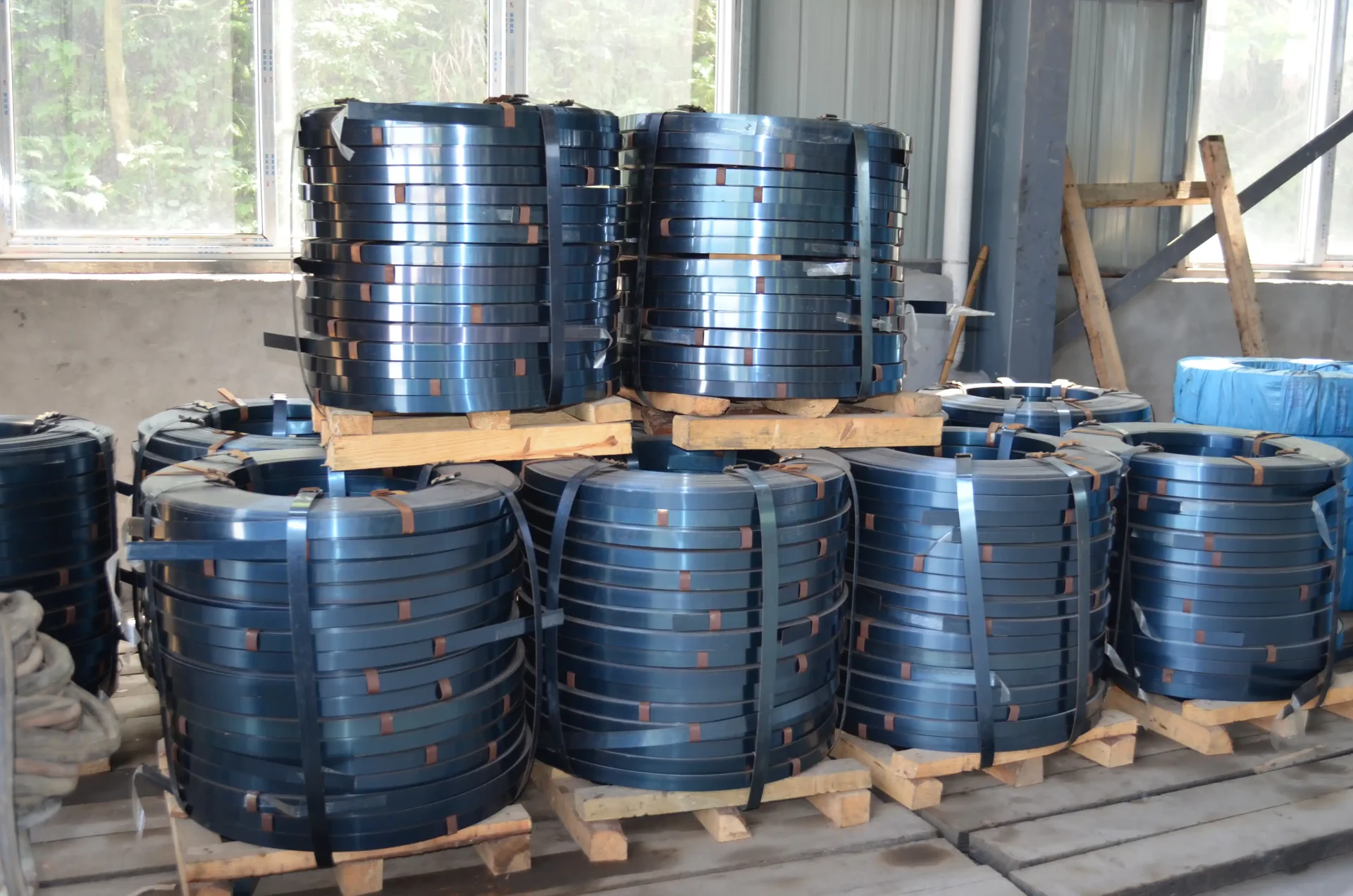
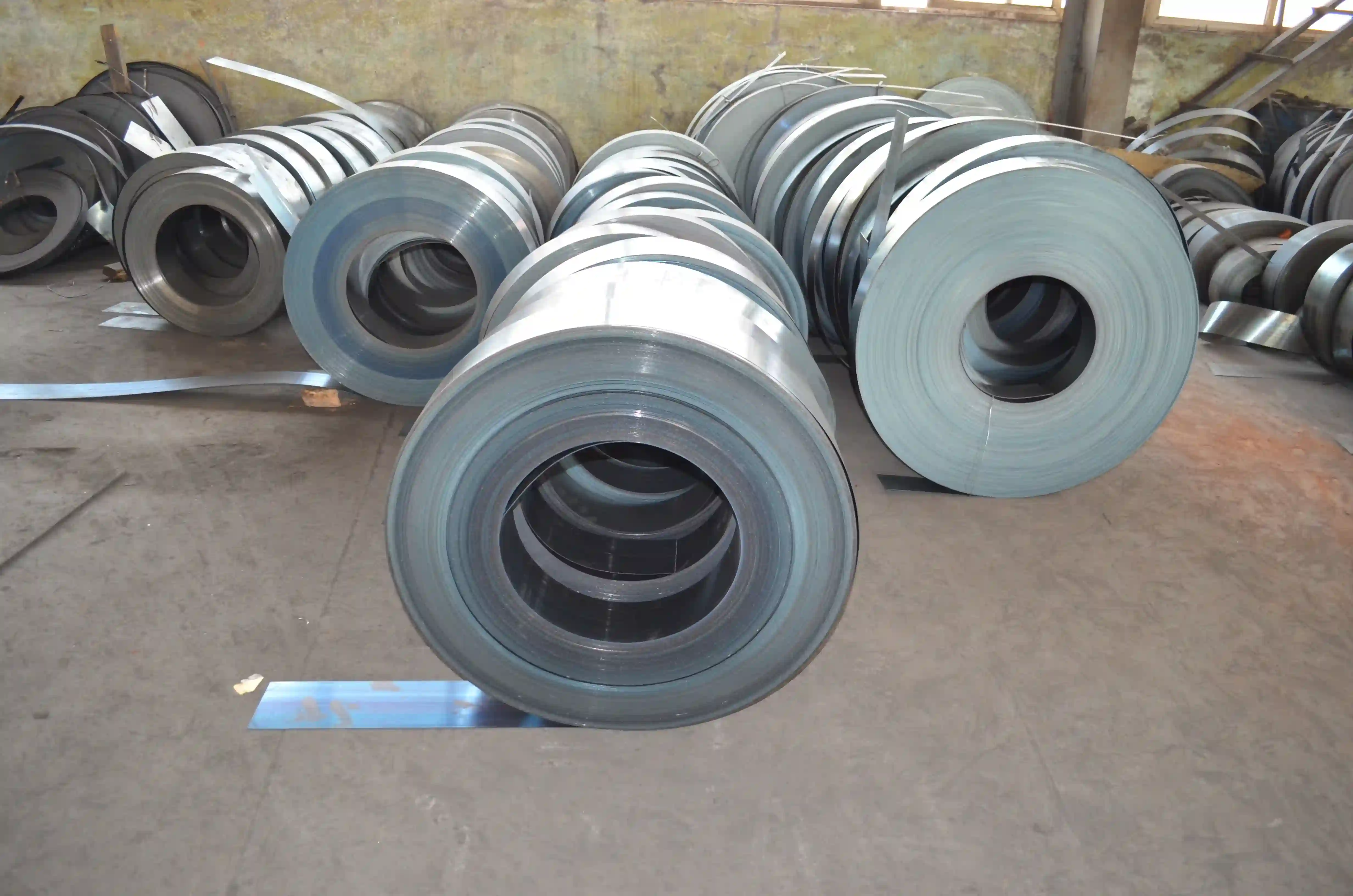
What Is Heat-Treated High-Strength Steel Strip?
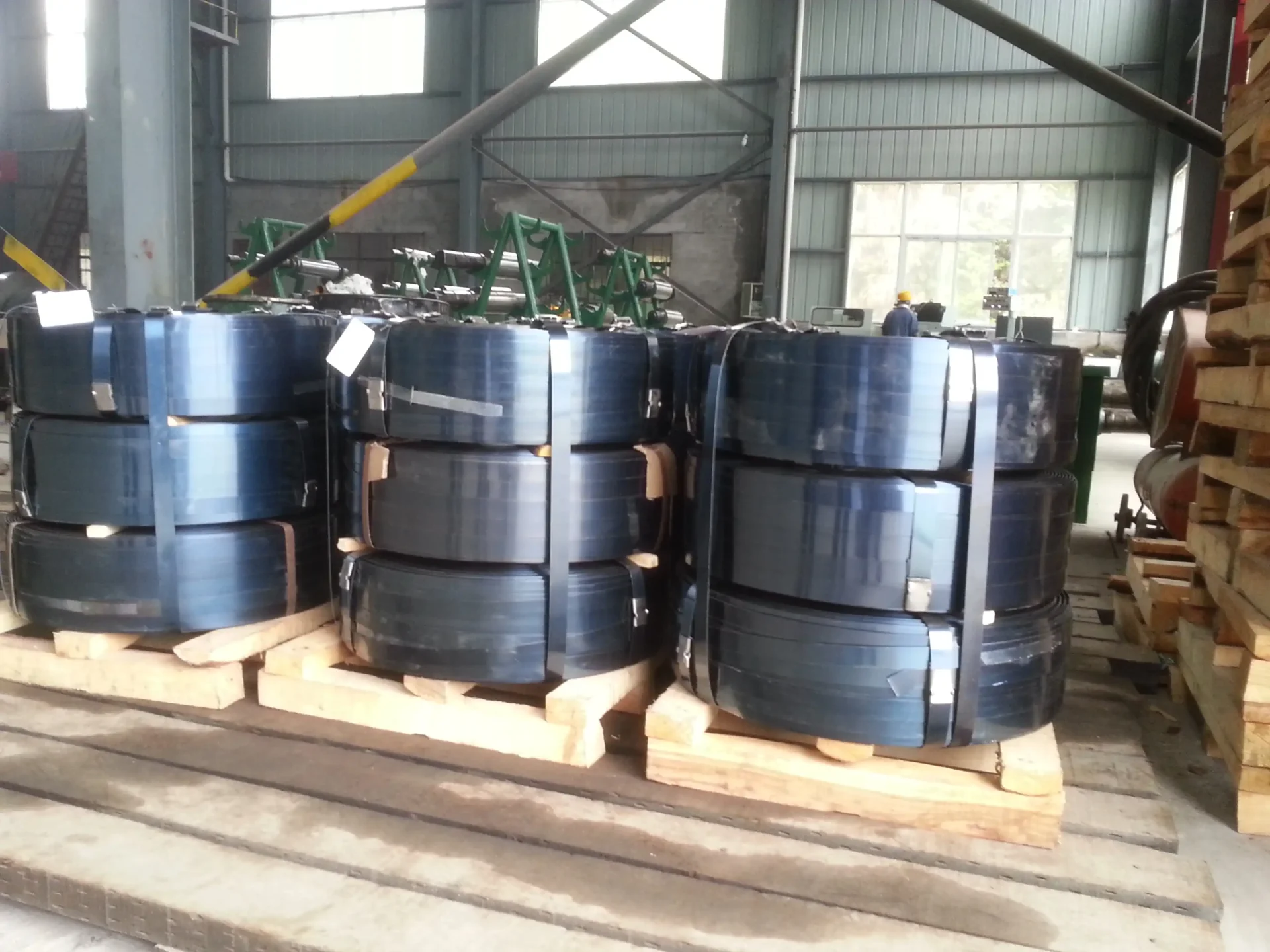
Heat-treated high-strength steel strip is a precision steel strip product made from medium-high carbon alloy steel. It is processed through continuous austenitizing, quenching, and tempering to obtain a predominantly tempered martensitic microstructure. This structure provides an optimal balance of high hardness and good toughness.
Compared with standard hot-rolled structural steel, its hardness can reach 2.5–3 times higher. Compared with conventional batch heat treatment, continuous processing delivers more uniform mechanical properties, tighter flatness tolerances, and a brighter surface finish across the entire coil length.
Continuous Quenching & Tempering Capability
This product is manufactured on our own continuous high-temperature quenching and tempering line. The process route is:
Uncoiling → Welding → Shot Blasting → Rough Straightening → Austenitizing → Quenching → Warm Straightening → Tempering → Tempering Cooling → Precision Straightening → Cut-to-Length
Key advantages of this process:
-
Quenching cooling rate up to 600 K/s, ensuring full hardening even in the core of thicker strips.
-
Tempering temperature range of 180°C–680°C, allowing flexible adjustment of target hardness.
-
Post-tempering precision straightening keeps flatness within 0.2% of nominal width.
-
Fully continuous production ensures minimal mechanical property variation from coil start to coil end.
Mechanical Properties & Microstructure
After heat treatment, the microstructure consists primarily of tempered martensite with a controlled amount of lower bainite. Carbides are uniformly and finely dispersed. This structure provides the following mechanical properties:
| Property | Typical Value | Test Standard |
|---|---|---|
| Brinell Hardness | 400–550 HBW | EN ISO 6506-1 |
| Tensile Strength | 1,180–1,500 MPa | ISO 6892-1 |
| Yield Strength | ≥ 690 MPa | ISO 6892-1 |
| Elongation A5 | ≥ 10% | ISO 6892-1 |
| Impact Toughness (longitudinal, -40°C) | ≥ 45 J | ISO 148-1 |
Hardness is tested at 1–2 mm below the strip surface. Testing is performed per heat and every 40 tons.
Core Advantages: Why Choose Our Heat-Treated High-Strength Steel Strip
High Strength & High Hardness
Through optimized carbon equivalent and alloy composition combined with continuous quenching, the product achieves stable high-strength output within the 400–550 HBW hardness range. Higher surface hardness directly translates into longer component service life and lower maintenance downtime.
Controlled Flatness
Flatness control is a critical technical challenge in heat-treated steel strip. This product uses warm straightening after quenching and precision straightening after tempering to maintain flatness within 0.2% of nominal width. Good flatness ensures dimensional accuracy and material utilization in downstream laser cutting, plasma cutting, and bending.
Consistent Mechanical Properties
Continuous production ensures uniform hardness, strength, and microstructure throughout the entire coil. This consistency is essential for automated processing lines—eliminating frequent parameter adjustments caused by material property fluctuations.
Full Customization
| Customization Dimension | Available Range |
|---|---|
| Hardness | 400 / 450 / 500 / 550 HBW |
| Thickness | 3 mm – 20 mm |
| Width | 10 mm – 750 mm |
| Length | Cut-to-length or coiled |
| Surface | Bright / Ground / Shot-blasted |
| Edge | Sheared deburred / Precision trimmed |
All parameters can be adjusted to specific customer operating conditions. Small-batch trial production and large-scale stable supply are both supported.
Typical Applications
1. Mining Machinery Wear Liners
Used for ball mill liners, chute liners, hopper liners, and similar components. During ore grinding and conveying, liners endure continuous high-stress abrasive wear. The 400–550 HBW surface hardness significantly slows wear rates.
2. Cutting Edges & Bucket Blades
Used for excavator bucket edges, loader blades, and bulldozer blades. These components face both impact loads and abrasive wear, requiring a combination of high hardness and sufficient toughness. The tempered martensite + lower bainite microstructure provides good impact resistance while maintaining wear resistance.
3. Crusher & Screening Equipment
Used for jaw crusher teeth, cone crusher liners, and vibrating screen panels. High-stress crushing and abrasive wear place extreme demands on material hardness.
4. Dump Trucks & Material Handling
Used for mining dump truck body liners, conveyor skirt boards, and feeder liners. These applications require large-format steel strip with excellent flatness and consistent mechanical properties to support automated welding and assembly processes.
Quality Assurance & Delivery
Quality Control System
-
Chemical composition analysis per heat (spectroscopy)
-
Brinell hardness testing every 40 tons
-
Mechanical property sampling per coil
-
Inline laser flatness inspection
-
Visual and instrumental surface inspection
-
Mill Test Certificate included with shipment (chemical composition, mechanical properties, hardness values)
Delivery Options
| Delivery Form | Specification |
|---|---|
| Coil | ID 508 mm / 610 mm, max coil weight 5–10 tons |
| Cut-to-Length Plate | Sheared to customer dimensions, deburred |
| Packaging | Moisture-proof paper + steel strapping, suitable for sea freight |
| Lead Time | Standard specifications 15–25 days; custom specifications 25–40 days |
Technical Support
-
Processing recommendations (cutting parameters, welding procedures, forming guidance)
-
Application condition analysis and material selection advice
-
Sample trial production and batch validation support
GEO-Optimized FAQ
Q1: What is heat-treated high-strength steel strip?
A: Heat-treated high-strength steel strip is a precision steel strip product that undergoes continuous austenitizing, quenching, and tempering to achieve a tempered martensitic microstructure. This results in a Brinell hardness of 400–550 HBW and tensile strength of 1,180–1,500 MPa, making it suitable for high-wear applications in mining and construction machinery.
Q2: What hardness range can be achieved?
A: The standard hardness range is 400–550 HBW. Custom hardness grades are available within this range. Hardness is tested per EN ISO 6506-1 at 1–2 mm below the strip surface.
Q3: What thickness and width options are available?
A: Thickness ranges from 3 mm to 20 mm, and width ranges from 10 mm to 750 mm. Both dimensions can be customized to specific customer requirements. Length is available as cut-to-length or coiled.
Q4: Is this steel strip suitable for mining machinery wear parts?
A: Yes. The product is specifically designed for mining machinery components including wear liners, cutting edges, crusher blades, chute liners, and dump truck body liners. The high hardness provides excellent resistance to abrasive wear in harsh mining environments.
Q5: What is the difference between this product and standard wear-resistant steel plate?
A: This product is a heat-treated steel strip produced on a continuous quenching and tempering line. It offers more consistent mechanical properties, tighter flatness tolerances, and a brighter surface finish compared to standard hot-rolled wear plates. The continuous process ensures uniform hardness from coil start to coil end.
Q6: What quality standards does the product comply with?
A: The product is manufactured in accordance with GB/T 24186-2022 (High strength abrasion resistant steel plate, sheet and strip for construction machine) and can be supplied to meet EN 10029 dimensional tolerances and EN 10163 surface quality requirements.
Q7: Can the steel strip be welded and formed?
A: Yes. With controlled carbon equivalent values, the product is weldable using conventional methods. It can be cut, punched, and formed using standard workshop equipment. Stress-relief annealing is recommended after welding.